Wavelength to Frequency Calculator
Convert electromagnetic wavelength to frequency in Hz, kHz, MHz, GHz or THz. Enter a wavelength in meters, centimeters, millimeters, micrometers, nanometers or inches.
Frequency · f
299792000 Hz · 0.299792 GHz · 0.000299792 THz
- Input wavelength
- 1 m
- Wave period · T = 1/f
- 3.33564 ns
f = 299,792,458 ÷ 1 ≈ 299792000 Hz
Uses c = 299,792,458 m/s in vacuum. Results are rounded to six significant figures. Enter the full wavelength, not an antenna's physical length.


Wavelength to Frequency Calculator
The wavelength to frequency calculator converts electromagnetic wavelength (in meters) into frequency (in Hz) using the formula f = c / λ, where c is the speed of light (3 × 10⁸ m/s). This conversion is essential in RF engineering, antenna design, telecommunications, and wireless communication systems.
How to convert wavelength to frequency
- Enter a positive wavelength and choose its unit.
- Select an output frequency unit, or let Auto choose a suitable unit.
- Select Calculate frequency to see frequency, equivalent units and wave period.
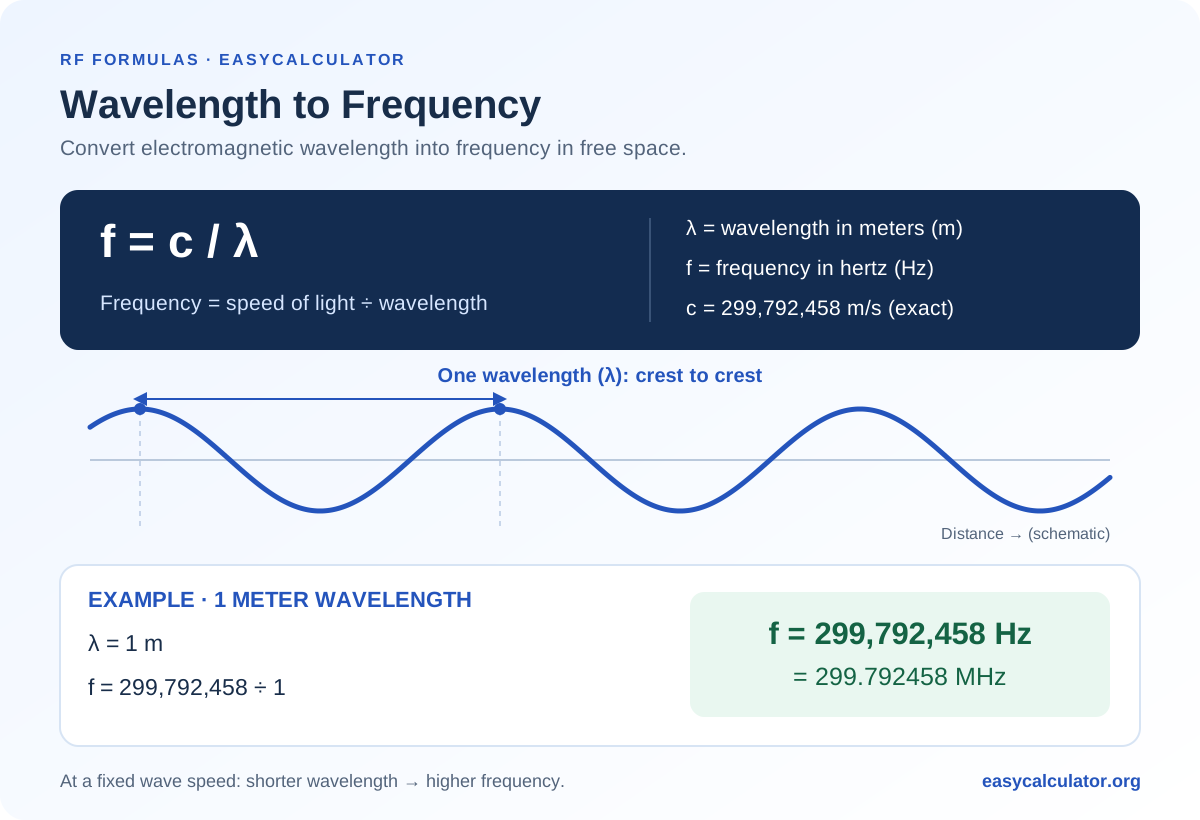
Wavelength is the distance between matching points on consecutive wave cycles, such as crest to crest. Frequency counts the number of cycles per second. One hertz means one cycle per second. For waves traveling at a fixed speed, a shorter wavelength means a higher frequency.
Wavelength to frequency formula
f = c / λ
f is frequency in hertz, λ is wavelength in meters, and c = 299,792,458 m/s is the exact speed of light in vacuum.
Meters to MHz: f (MHz) = 299.792458 / λ (m)
Centimeters to GHz: f (GHz) = 29.9792458 / λ (cm)
Millimeters to GHz: f (GHz) = 299.792458 / λ (mm)
Nanometers to THz: f (THz) = 299792.458 / λ (nm)
The shortcut 300 / λ (m) estimates frequency in MHz. The calculator uses the exact constant documented by NIST, then rounds the displayed result.
Wavelength to frequency examples
1 meter to frequency
f = 299,792,458 / 1
= 299,792,458 Hz
= 299.792458 MHz.
The calculator displays 299.792 MHz after rounding to six significant figures. The corresponding period is approximately 3.33564 ns.
12.5 cm to frequency
First convert 12.5 cm to 0.125 m.
f = 299,792,458 / 0.125
= 2,398,339,664 Hz
≈ 2.39834 GHz.
This is close to 2.4 GHz; the difference comes from using the exact speed of light rather than 300,000,000 m/s.
550 nm to frequency of light
550 nm = 0.00000055 m. Dividing 299,792,458 by this wavelength gives approximately 5.45077 × 10¹⁴ Hz, or 545.077 THz. Use the vacuum wavelength for this calculation.
Wavelength to frequency conversion table
| Wavelength | Wavelength (m) | Frequency |
|---|---|---|
| 100 m | 100 | 2.99792 MHz |
| 10 m | 10 | 29.9792 MHz |
| 2 m | 2 | 149.896 MHz |
| 1 m | 1 | 299.792 MHz |
| 50 cm | 0.5 | 599.585 MHz |
| 30 cm | 0.3 | 999.308 MHz |
| 12.5 cm | 0.125 | 2.39834 GHz |
| 10 cm | 0.1 | 2.99792 GHz |
| 5 cm | 0.05 | 5.99585 GHz |
| 10 mm | 0.01 | 29.9792 GHz |
| 5 mm | 0.005 | 59.9585 GHz |
| 1 mm | 0.001 | 299.792 GHz |
| 550 nm | 5.5e-07 | 545.077 THz |
Wavelength is not the same as antenna length
A full wavelength is the distance occupied by one complete wave cycle. A theoretical half-wave dipole has a total length near λ/2; a quarter-wave monopole has a radiating element near λ/4.
For example, a theoretical 0.5 m half-wave dipole corresponds to a full wavelength of 1 m, giving approximately 299.792 MHz. Entering 0.5 m directly would instead calculate the frequency of a full 0.5 m wave. Practical antenna lengths also depend on geometry, end effects, insulation and surroundings.
Use the frequency to wavelength calculator for theoretical full, half and quarter wavelengths. Check propagation with the free space path loss calculator and mismatch with the VSWR calculator.
Wavelength in air, cables and other media
The general equation is f = v / λ, where v is the phase speed in the medium. This calculator uses the speed of light in vacuum, a common approximation for RF propagation in air. For a wavelength measured inside a cable, use the cable's phase speed instead.
For example, with a cable velocity factor of 0.66 and a wavelength of 1 m inside that cable, f = 299,792,458 × 0.66 / 1 ≈ 197.863 MHz. The same frequency has a longer wavelength in free space. Sound waves require the speed of sound in their medium and are outside this tool's scope.
FAQ on Wavelength to frequency Calculator
Divide 299.792458 by the wavelength in meters. A 2 m free-space wavelength corresponds to approximately 149.896 MHz.
Convert nanometers to meters by multiplying by 10⁻⁹, then divide 299,792,458 by that value. A 550 nm vacuum wavelength corresponds to approximately 5.45077 × 10¹⁴ Hz.
In vacuum, a wavelength of 1 meter corresponds to exactly 299,792,458 Hz, or 299.792458 MHz. The calculator displays a rounded result.
Yes, when wave speed is fixed. Frequency and wavelength are inversely proportional, so halving the wavelength doubles the frequency.
Enter the full wavelength. For an ideal half-wave antenna, double its total length to estimate the wavelength; for an ideal quarter-wave element, multiply its length by four. Real antennas require corrections and tuning.
Period is the time for one complete cycle. It equals 1 divided by frequency in hertz and is measured in seconds. For high RF frequencies, nanoseconds or picoseconds are often more convenient.