Free Space Path Loss (FSPL) Calculator
Calculate ideal radio path loss from distance and frequency. Add transmitter power, antenna gains and system losses to estimate received power.
Enter distance and frequency to calculate.
Ideal free-space, far-field estimate. This result does not establish coverage or link reliability.


What is free space path loss?
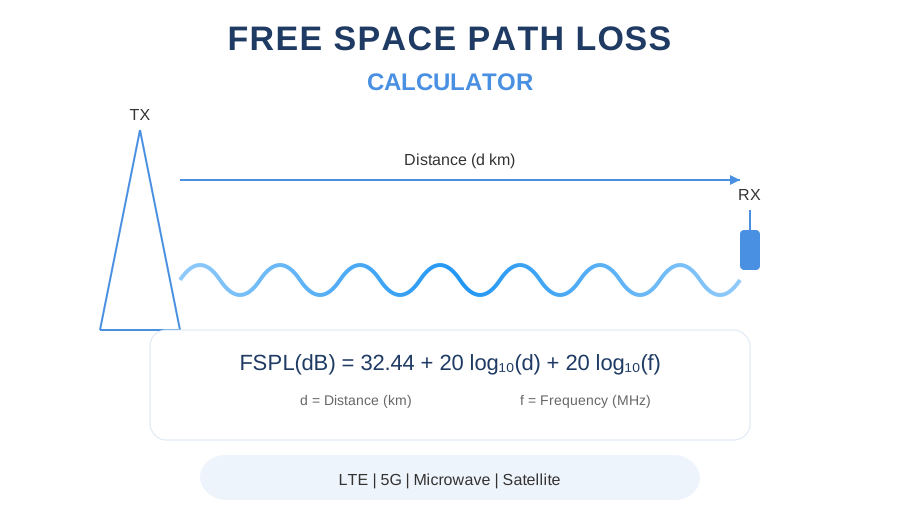
Free space path loss (FSPL), also called free space loss (FSL), describes the reduction in received power between ideal isotropic antennas as radio waves spread through unobstructed space. It is a baseline for Wi-Fi, cellular, microwave and satellite link calculations. It does not include antenna gains or environmental losses.
This free space path loss calculator converts your distance and frequency units automatically. Select a preset or enter positive values, then choose Calculate FSPL. Open Received power settings to account for transmitter power, both antenna gains and additional losses.
Free space path loss formula and equation
d = distance in meters; f = frequency in Hz; c = 299,792,458 m/s.
For the units most often used in telecom planning:
The commonly used constant 32.44 is a slightly different approximation. This calculator uses the exact speed of light throughout, giving a km/MHz constant of about 32.4478. Small differences of around 0.01 dB from rounded formulas are expected.
FSPL formula constants for meters, kilometers, MHz and GHz
In the equation 20 log₁₀(d) + 20 log₁₀(f) + K, select the constant for both units:
| Distance | Frequency | K (dB) |
|---|---|---|
| km | MHz | +32.45 |
| km | GHz | +92.45 |
| m | MHz | −27.55 |
| m | GHz | +32.45 |
| m | Hz | −147.55 |
For example, 1 km at 2400 MHz is the same input as 1000 m at 2.4 GHz. Using a km/MHz constant with meters introduces a 60 dB error.
Linear free space loss and wavelength
The linear power-loss ratio is L = (4πd/λ)², where wavelength λ = c/f. Convert this ratio to decibels using FSPL = 10 log₁₀(L). Use the frequency to wavelength calculator to convert between frequency and wavelength.
FSPL example: 2.4 GHz over 5 km
For a 5 km free-space path at 2400 MHz:
= 13.9794 + 67.6042 + 32.4478
FSPL ≈ 114.03 dB
With 0 dBm transmitter power, 2 dBi TX gain, 2 dBi RX gain and no additional losses:
Received power ≈ −110.03 dBm
Increasing transmitter power to 20 dBm raises received power to approximately −90.03 dBm. The FSPL remains 114.03 dB because the frequency and distance have not changed.
Free space path loss reference table
Compare common RF frequencies at distances from 100 m to 20 km. Values use the same formula as the calculator and exclude antenna gains and other losses.
| Distance | 700 MHz | 900 MHz | 1800 MHz | 2100 MHz | 2400 MHz | 2500 MHz | 3500 MHz | 5000 MHz |
|---|---|---|---|---|---|---|---|---|
| 100 m | 69.35 | 71.53 | 77.55 | 78.89 | 80.05 | 80.41 | 83.33 | 86.43 |
| 200 m | 75.37 | 77.55 | 83.57 | 84.91 | 86.07 | 86.43 | 89.35 | 92.45 |
| 500 m | 83.33 | 85.51 | 91.53 | 92.87 | 94.03 | 94.39 | 97.31 | 100.41 |
| 1 km | 89.35 | 91.53 | 97.55 | 98.89 | 100.05 | 100.41 | 103.33 | 106.43 |
| 5 km | 103.33 | 105.51 | 111.53 | 112.87 | 114.03 | 114.39 | 117.31 | 120.41 |
| 10 km | 109.35 | 111.53 | 117.55 | 118.89 | 120.05 | 120.41 | 123.33 | 126.43 |
| 20 km | 115.37 | 117.55 | 123.57 | 124.91 | 126.07 | 126.43 | 129.35 | 132.45 |
How distance and frequency affect path loss
Doubling distance adds approximately 6.02 dB of FSPL. Increasing distance tenfold adds 20 dB. Loss therefore does not increase by a fixed number of dB per kilometer.
Doubling frequency also adds about 6.02 dB when antenna gains in dBi stay the same. At 100 m, free-space loss is approximately 80.05 dB at 2.4 GHz and 86.43 dB at 5 GHz. The difference is 6.38 dB.
This frequency comparison assumes fixed antenna gains. Antennas with a fixed physical aperture can have higher gain at higher frequencies, so the FSPL number alone does not determine which complete radio system performs better.
FSPL vs. a complete RF link budget
FSPL is one loss term in a link budget. Estimate received power with:
Here, L is the total of additional losses you enter. Compare received power with receiver sensitivity and include a suitable fade margin before judging a link. Use the RF link budget calculator for that next step, or the EIRP calculator to account for transmit antenna gain and feeder loss.
When this model is useful—and when it is insufficient
- Wi-Fi: a useful outdoor baseline; indoor walls and reflections require additional modeling.
- 4G and 5G: a starting comparison across bands, not a standalone prediction of site coverage.
- Microwave: check line of sight, Fresnel clearance, rain and fading as well as FSPL.
- Satellite: use the slant distance to the satellite and consider atmospheric and other system losses.
The free-space link equation assumes far-field propagation. For an electrically large antenna, a common far-field criterion is d ≥ 2D²/λ, with D the largest antenna dimension. Antenna dimensions and geometry are needed to assess validity; this tool cannot confirm it from distance and frequency alone.
Reference: ITU-R P.525 — Calculation of free-space attenuation.
FSPL calculator FAQs
What is free space path loss (FSPL)?
FSPL is the ratio of transmitted power to received power between ideal isotropic antennas in free space. It depends on distance and frequency and is normally expressed in dB. It is also called free space loss or FSL.
What is the FSPL formula for km and MHz?
FSPL (dB) ≈ 20 log10(distance in km) + 20 log10(frequency in MHz) + 32.45. The calculator uses the speed of light, 299,792,458 m/s, rather than a rounded constant.
How do I calculate FSPL in meters?
For distance in meters and frequency in MHz, use a constant of −27.55 dB. For meters and GHz, use +32.45 dB. For meters and Hz, use −147.55 dB. Always match both units to the constant.
Does antenna gain change free space path loss?
No. Antenna gains change received power, not FSPL. Received power equals transmit power plus transmit and receive antenna gains, minus FSPL and other system losses.
What happens when distance or frequency doubles?
Doubling distance increases FSPL by approximately 6.02 dB. Doubling frequency also increases FSPL by approximately 6.02 dB when antenna gains in dBi are held constant.
What is the free space path loss at 2.4 GHz over 1 km?
At 2.4 GHz over 1 km, FSPL is approximately 100.05 dB. At 5 km it is approximately 114.03 dB, using the exact speed of light.
Can this calculator predict indoor Wi-Fi or cellular coverage?
FSPL provides an ideal free-space baseline. It does not model walls, terrain, diffraction, reflections, foliage, interference or fading. Real coverage planning requires an appropriate propagation model and measured site data.
Can I use the FSPL equation in the antenna near field?
The free-space link equation assumes far-field propagation. A common far-field distance criterion for electrically large antennas is 2D²/λ, where D is the largest antenna dimension and λ is wavelength. Distance and frequency alone cannot establish far-field validity for every antenna.