📡 Fresnel Zone Calculator
Calculate Fresnel radius for wireless link clearance
Enter parameters and click Calculate


What is a Fresnel Zone?
A Fresnel Zone is the three-dimensional elliptical area surrounding the direct radio path between a transmitter and receiver. To maintain reliable wireless communication, at least 60% of the first Fresnel zone should remain clear of obstacles. The Fresnel radius depends on frequency, total path length, and obstacle location.
- Distance between antennas
- Frequency of the signal
- Location of obstacles along the path
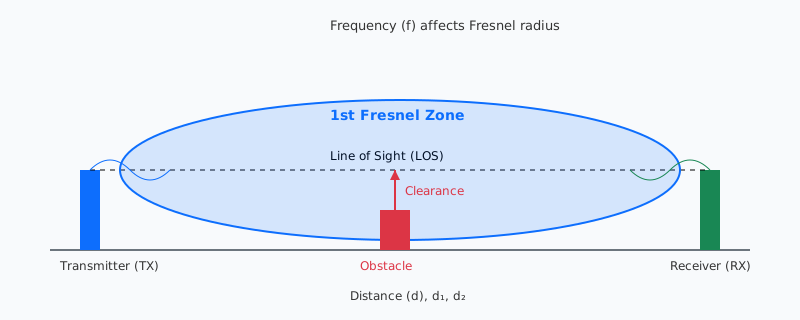
Why Fresnel Zone Matters in RF Communication
In wireless systems like 4G LTE, 5G, microwave links, and WiFi bridges, having visual line-of-sight is not enough. Obstacles inside the Fresnel zone cause signal diffraction and attenuation, leading to poor performance.
- ✔ Signal diffraction due to obstacles
- ✔ Reduced signal strength
- ✔ Link instability or failure
Fresnel Zone Formula
Where R is radius, λ is wavelength, d₁ and d₂ are distances, and d is total link distance.
Fresnel Zone Clearance Calculation
Fresnel zone: Let D be the distance between the transmitter and receiver. The radius of the first Fresnel zone (n=1) at point P is denoted as r. Point P is located at distances $d_1$ and $d_2$ from the transmitter and receiver respectively.
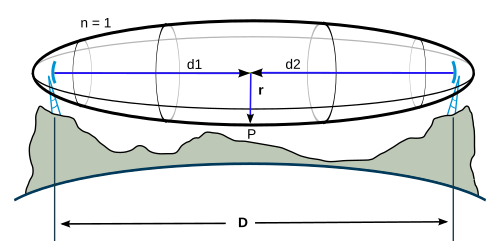
The concept of Fresnel zone clearance is used to analyze interference caused by obstacles near the path of a radio signal. The first Fresnel zone must be mostly free of obstructions to ensure reliable communication.
✔ Maximum obstruction allowed: 40%
✔ Recommended obstruction: ≤ 20%
RF Line of Sight (LoS)
The RF line of sight is the straight path between transmitting and receiving antennas. The Fresnel zone surrounds this path and represents the region where radio waves propagate.
The radius of the Fresnel zone is maximum at the midpoint and decreases toward the antennas.
Mathematical Formulation
Consider a point P located at distances $d_1$ and $d_2$ from the antennas. The Fresnel zone is defined by the difference between reflected and direct path lengths:
Where:
- $D = d_1 + d_2$ (total distance)
- $\lambda$ = wavelength
- $n$ = Fresnel zone number
Approximation
Assuming $d_1, d_2 \gg r_n$, using binomial approximation:
Final Fresnel Radius Formula
Valid when $d_1, d_2 \gg n\lambda$
Satellite-to-Earth Simplification
Where $d_2 \approx D$ and $d_1 \gg n\lambda$
How to Use Fresnel Zone Calculator
- Enter total distance
- Enter frequency
- Select Fresnel zone
- Enter obstacle distance (optional)
- Click Calculate
Example Calculation
Distance: 5 km
Frequency: 5.8 GHz
Fresnel Radius ≈ 8.7 meters
Recommended clearance ≈ 5.2 meters (60%)
Fresnel Clearance Guidelines
| Clearance | Impact |
|---|---|
| 100% | Ideal performance |
| ≥ 60% | Acceptable |
| < 60% | Signal degradation |
| < 40% | Link failure |
Applications of Fresnel Zone
Fresnel Zone vs Line of Sight
| Factor | LOS | Fresnel Zone |
|---|---|---|
| Definition | Visual path | Signal region |
| Importance | Basic | Critical |
| Clearance | 0% | ≥ 60% |
Fresnel Radius Reference Table
The table below shows approximate first Fresnel zone radius values at the midpoint for common wireless link distances and frequencies.
| Distance | Frequency | Approx. Radius |
|---|---|---|
| 1 km | 2.4 GHz | 5.6 m |
| 5 km | 2.4 GHz | 12.5 m |
| 5 km | 5 GHz | 8.7 m |
| 10 km | 6 GHz | 11.9 m |
| 20 km | 11 GHz | 16.5 m |
How Frequency Affects Fresnel Zone Radius
The Fresnel zone radius decreases as the operating frequency increases. Higher-frequency wireless systems require a smaller Fresnel clearance than lower-frequency systems over the same link distance.
| Frequency | Relative Fresnel Radius | Typical Applications |
|---|---|---|
| 900 MHz | Largest | Cellular, IoT |
| 2.4 GHz | Medium | WiFi, Bluetooth |
| 5 GHz | Smaller | WiFi, Wireless Bridge |
| 6 GHz | Smaller | WiFi 6E, Microwave |
| 11 GHz | Small | Microwave Backhaul |
| 18 GHz | Very Small | High-Capacity Microwave Links |
FAQ on Fresnel Zone Calculator
The first Fresnel zone is the most critical region where radio signals travel. It must be mostly clear to avoid signal loss.
It minimizes diffraction and ensures strong signal performance.
Yes, higher frequencies produce smaller Fresnel zones.
Yes. The Fresnel Zone is very important for long-distance WiFi links, especially outdoor point-to-point and point-to-multipoint connections using 2.4 GHz, 5 GHz, or 6 GHz frequencies. Even if the antennas have a clear visual line of sight, obstacles inside the Fresnel Zone can weaken the signal and reduce throughput. Maintaining at least 60% Fresnel Zone clearance helps ensure maximum signal strength, higher data speeds, and a stable wireless connection.
Yes. A 5 GHz signal has a smaller Fresnel Zone radius than lower frequencies such as 2.4 GHz over the same distance. While the required clearance area is smaller, you should still maintain at least 60% of the first Fresnel Zone free of obstacles for reliable communication.
Yes. Increasing antenna height can improve Fresnel Zone clearance by raising the radio path above trees, buildings, and terrain. Proper antenna height is essential for maintaining the recommended 60% clearance and reducing signal loss caused by diffraction.
Trees should ideally not obstruct the first Fresnel Zone. As a general guideline, keep at least 60% of the Fresnel Zone clear. Dense vegetation inside the Fresnel Zone can absorb and scatter radio waves, reducing signal strength and link reliability, especially at higher frequencies such as 5 GHz and 6 GHz.
When the Fresnel Zone is partially or completely blocked by obstacles such as trees, buildings, or hills, radio waves experience diffraction and attenuation. This can result in lower signal strength, reduced data throughput, higher packet loss, unstable connections, and, in severe cases, complete link failure.