EIRP Calculator
Calculate effective isotropic radiated power in dBm and watts from transmitter power, antenna gain and feed losses. Compare EIRP with ERP and see each calculation step.
ERP: 31.85 dBm · 1.53109 W
30 dBm + 6 dBi − 2 dB − 0 dB = 34 dBm


What is EIRP?
EIRP (effective isotropic radiated power), also called equivalent isotropically radiated power, is the power an ideal isotropic antenna would need to produce the same power density as your antenna in a specified direction. Antenna specifications usually give maximum gain, so the result normally represents EIRP in the main beam.
EIRP is not the total power radiated in all directions. A directional antenna concentrates radiation; it does not create additional transmitter power. This is why a 1 W transmitter can have an EIRP greater than 1 W.
EIRP formula
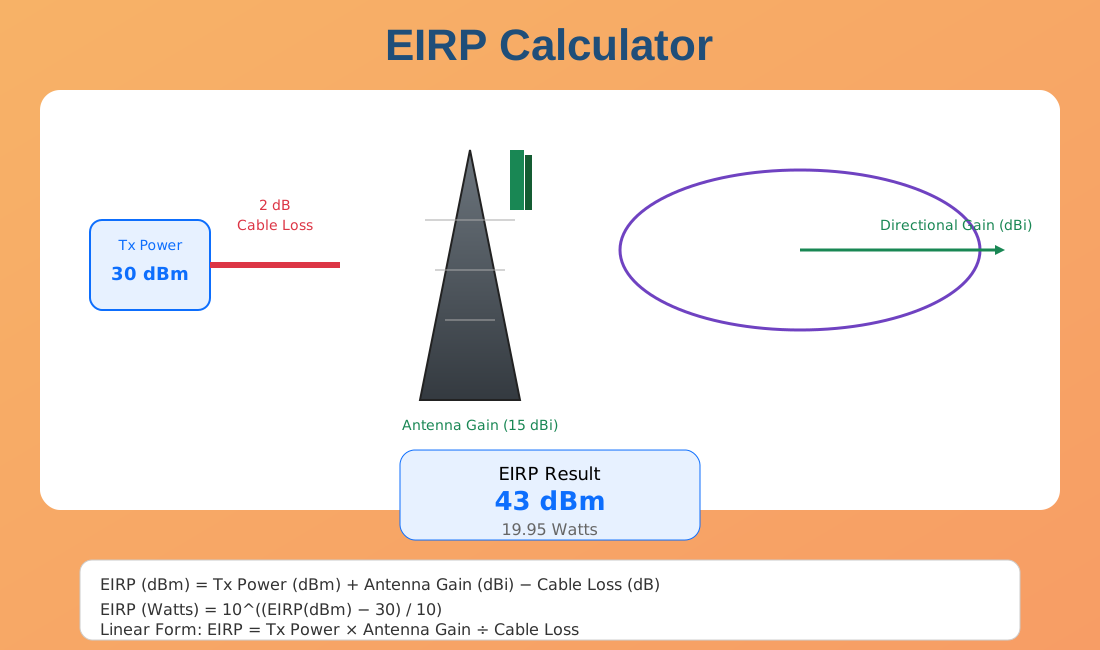
EIRP (dBm) = PTX (dBm) + G (dBi) − Lcable (dB) − Lother (dB)
Use transmitter power measured before the listed feed losses. If your power is already measured at the antenna input, do not subtract those same losses again.
- Power conversion: P (dBm) = 10 log10(P in watts) + 30.
- Linear EIRP: EIRP (W) = 10(EIRP in dBm − 30) / 10.
- Equivalent linear formula: EIRP (W) = PTX (W) × 10(G − Lcable − Lother) / 10, using gain in dBi and losses in dB.
- Gain conversion: G (dBi) ≈ G (dBd) + 2.15.
How to use this EIRP calculator
- Enter transmitter output power and select dBm, dBW, W or mW.
- Enter antenna gain and choose dBi or dBd according to the antenna datasheet.
- Enter cable loss and any additional feed losses as nonnegative dB values.
- Select Calculate EIRP to see EIRP, ERP and the calculation steps. Changing inputs clears the previous result until you calculate again.
Negative dBm values are valid: −10 dBm is 0.1 mW. Watts and milliwatts must be greater than zero. Changing a unit selects how the entered number is interpreted; it does not convert the input number.
EIRP calculation examples
For a 30 dBm transmitter, 6 dBi antenna and 2 dB cable loss, with no other losses:
EIRP = 30 + 6 − 2 − 0 = 34 dBm
EIRP = 10(34 − 30) / 10 ≈ 2.512 W
| TX power | Gain | Total feed loss | EIRP (dBm) | EIRP (W) |
|---|---|---|---|---|
| 20 dBm | 5 dBi | 1 dB | 24 | 0.2512 |
| 30 dBm | 6 dBi | 2 dB | 34 | 2.5119 |
| 40 dBm | 17 dBi | 3 dB | 54 | 251.1886 |
| 1 W (30 dBm) | 3 dBd (5.15 dBi) | 1 dB | 34.15 | 2.6002 |
EIRP vs ERP: what is the difference?
EIRP uses an isotropic antenna as its reference. ERP (effective radiated power) uses a half-wave dipole. For the same system, EIRP is approximately 2.15 dB higher than ERP.
ERP (dBm) = EIRP (dBm) − 2.15
ERP (W) = EIRP (W) ÷ 102.15 / 10
For the default example, 34 dBm EIRP corresponds to 31.85 dBm ERP, or about 1.531 W. Do not subtract 2.15 directly from a value in watts.
FAQ on EIRP Calculator
A good EIRP depends on the application. For Wi-Fi, it is usually below regulatory limits, while telecom networks use higher values for better coverage.
EIRP in dBm represents the effective radiated power in logarithmic scale, combining transmitter power, antenna gain, and losses.
EIRP=Transmitter Power (dBm) + Antenna Gain (dBi) − Cable Loss (dB) − Other Losses (dB).
Antenna gain focuses energy in a direction, increasing effective radiated power compared to an isotropic antenna.
EIRP is referenced to an isotropic antenna, while ERP is referenced to a dipole antenna (ERP is ~2.15 dB lower than EIRP).