Frequency to Wavelength Calculator
Convert Hz, kHz, MHz or GHz to wavelength in meters, centimeters, millimeters or inches. Get full, half and quarter wavelengths for electromagnetic waves in free space.
Full wavelength · λ
33.3103 cm · 333.103 mm · 13.1143 in
- Half wavelength · λ/2
- 0.166551 m
- Quarter wavelength · λ/4
- 0.0832757 m
λ = 299,792,458 ÷ 900,000,000 ≈ 0.333103 m
Uses c = 299,792,458 m/s, the exact speed of light in vacuum. Half and quarter wavelengths are theoretical electrical lengths; practical antenna dimensions depend on the design and surroundings.


Frequency to Wavelength Calculator
The frequency to wavelength calculator converts electromagnetic frequency (in Hz) into wavelength (in meters) using the formula λ = c / f, where c is the speed of light (3 × 10⁸ m/s). This calculation is essential in antenna design, RF planning, telecommunications, and wireless system engineering.
How to convert frequency to wavelength
- Enter a positive frequency and select Hz, kHz, MHz or GHz.
- Choose your wavelength unit, then select Calculate wavelength.
- Read the full wavelength and the theoretical half-wave and quarter-wave lengths.
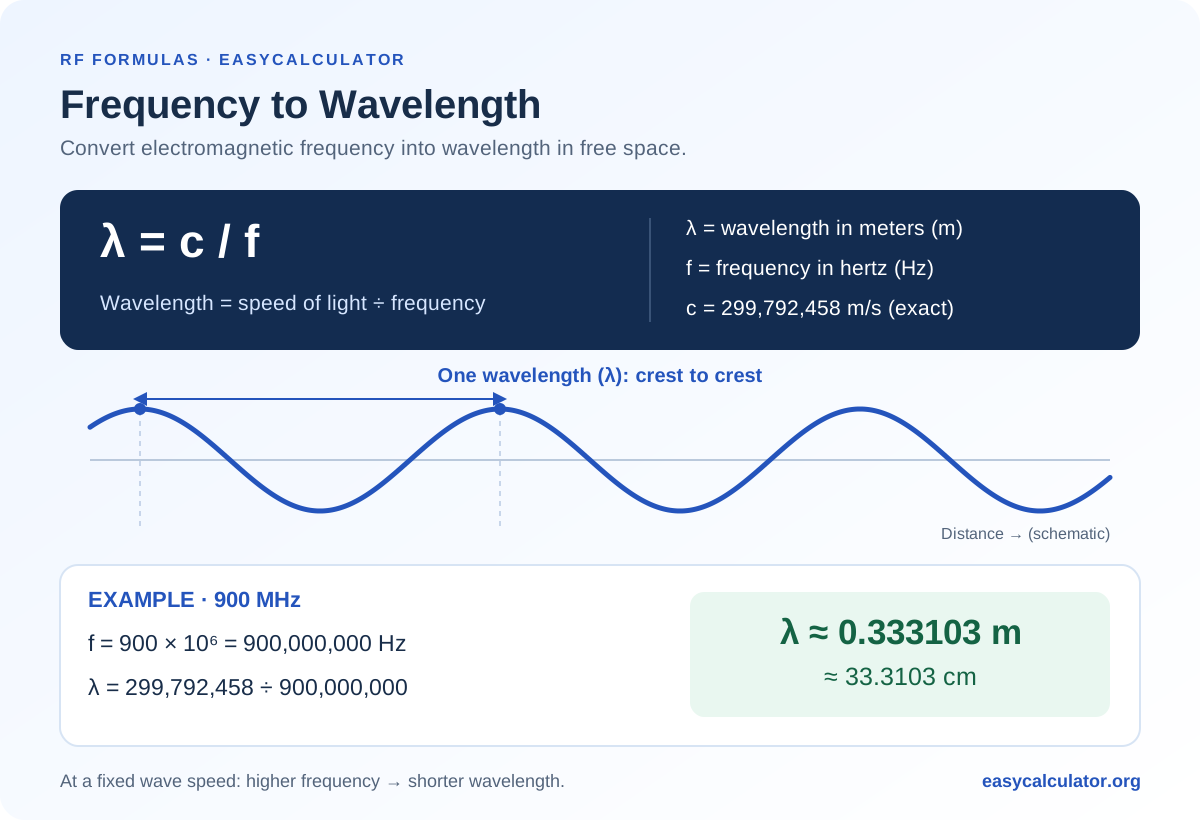
Frequency describes the number of cycles per second. Wavelength is the distance between corresponding points on consecutive cycles. At a fixed wave speed, doubling the frequency halves the wavelength.
Frequency to wavelength formula
λ = c / f
λ is wavelength in meters, f is frequency in hertz, and c = 299,792,458 m/s in vacuum.
MHz to meters: λ (m) = 299.792458 / f (MHz)
GHz to centimeters: λ (cm) = 29.9792458 / f (GHz)
GHz to millimeters: λ (mm) = 299.792458 / f (GHz)
For a quick estimate, use 300 / f (MHz) to get meters. The calculator uses the exact constant; displayed results are rounded to six significant figures. The exact constant is documented by NIST.
Worked RF examples
900 MHz to wavelength
900 MHz = 900,000,000 Hz.
λ = 299,792,458 / 900,000,000 ≈ 0.333103 m, or 33.3103 cm.
The theoretical quarter wavelength is approximately 8.32757 cm.
2.4 GHz to wavelength
2.4 GHz = 2,400,000,000 Hz.
λ = 299,792,458 / 2,400,000,000 ≈ 0.124914 m, or 12.4914 cm.
The theoretical quarter wavelength is approximately 3.12284 cm.
Frequency to wavelength conversion table
| Frequency | Wavelength (m) | Wavelength (cm) | Quarter wave (cm) |
|---|---|---|---|
| 1 MHz | 299.792 | 29979.2 | 7494.81 |
| 30 MHz | 9.99308 | 999.308 | 249.827 |
| 100 MHz | 2.99792 | 299.792 | 74.9481 |
| 150 MHz | 1.99862 | 199.862 | 49.9654 |
| 433 MHz | 0.692361 | 69.2361 | 17.309 |
| 700 MHz | 0.428275 | 42.8275 | 10.7069 |
| 900 MHz | 0.333103 | 33.3103 | 8.32757 |
| 1.8 GHz | 0.166551 | 16.6551 | 4.16378 |
| 2.1 GHz | 0.142758 | 14.2758 | 3.56896 |
| 2.4 GHz | 0.124914 | 12.4914 | 3.12284 |
| 3.5 GHz | 0.085655 | 8.5655 | 2.14137 |
| 5 GHz | 0.0599585 | 5.99585 | 1.49896 |
| 5.8 GHz | 0.0516884 | 5.16884 | 1.29221 |
Using wavelength in antenna and RF planning
A theoretical half-wave dipole spans λ/2 in total, and a quarter-wave monopole uses a radiating element near λ/4. These values are starting points: conductor diameter, end effects, ground plane, insulation and nearby objects can change the resonant length. Wavelength alone does not guarantee impedance matching.
For propagation calculations, pair this converter with the free space path loss calculator. Use the RF link budget calculator to include transmit power, gains and losses, and the VSWR calculator to investigate mismatch.
Free space, cables and other media
The general wave equation is λ = v / f, where v is the wave's phase speed in the medium. This tool uses the vacuum speed of light, a common approximation for radio waves in air.
In a cable with a specified velocity factor VF, the wavelength is λ = c × VF / f. For example, at 100 MHz and VF = 0.66, the cable wavelength is approximately 1.97863 m, compared with 2.99792 m in free space. Use the manufacturer's velocity factor for the cable and frequency in question. Sound requires the speed of sound in its medium and is outside this calculator's scope.
FAQ on Frequency to wavelength Calculator
Divide 299.792458 by the frequency in MHz. For example, 100 MHz has a free-space wavelength of approximately 2.99792 meters.
In free space, 1 GHz has a wavelength of 0.299792458 meters, or approximately 29.9792 centimeters.
In free space, 2.4 GHz corresponds to approximately 12.4914 cm, while 5 GHz corresponds to approximately 5.99585 cm.
At a fixed wave speed, yes. Wavelength is inversely proportional to frequency. When comparing different media, use the appropriate phase speed for each medium.
Use it as a theoretical starting point. Practical antenna dimensions depend on the antenna geometry, materials, ground plane, end effects and surroundings; tune and verify the actual antenna.
The shortcut uses an approximate speed of light of 300,000,000 m/s. This calculator uses 299,792,458 m/s, so its values are slightly smaller before rounding.