dBm to Watt Calculator
Convert dBm to Watts instantly and accurately.


dBm to Watt Conversion: Formula, Examples & Table
dBm to Wattconversion changes RF power from decibel-milliwatts (dBm) to Watts (W). Use this free dBm to Watt Calculatorto convert dBm values into Watts, milliwatts (mW), microwatts (µW), and nanowatts (nW).
Watt (W) is the SI unit of power, while dBm is a logarithmic unit referenced to 1 milliwatt. dBm is widely used in RF engineering, wireless communication, LTE and 5G networks, Wi-Fi, microwave systems, and fiber-optic communication.
How to Convert dBm to Watts
To convert a power level from dBm to Watts, use the following formula:
Where:
- P(W)=power in Watts
- P(dBm)=power level in dBm
The number 30appears in the formula because 0 dBm=1 mW=0.001 W. Since dBm uses a logarithmic scale, every 10 dB increase represents a 10× increase in power.
How Does the dBm Scale Work?
dBmmeans decibel-milliwatts. It expresses an absolute power level relative to 1 milliwatt (mW). This makes it convenient for describing both very small and very large RF power levels.
Some important reference values are:
- 0 dBm=1 mW=0.001 W
- 10 dBm=10 mW=0.01 W
- 20 dBm=100 mW=0.1 W
- 30 dBm=1 W
- 40 dBm=10 W
- 50 dBm=100 W
A 3 dB increaseis approximately a doubling of power, while a 10 dB increaseis exactly a 10× increase in power. For example, 43 dBm is approximately 19.95 W, and 46 dBm is approximately 39.81 W.
Power levels below 1 mW have negative dBm values, while power levels above 1 mW have positive dBm values.
Examples of dBm to Watt Conversion
The following examples show how to convert commonly used dBm values into Watts.
Example 1: Convert 43 dBm to Watts
Use the dBm to Watt formula:
Step 1:43 − 30=13
Step 2:13 ÷ 10=1.3
Step 3:101.3≈ 19.95
Therefore, 43 dBm ≈ 19.95 W, or approximately 20 Watts.
Example 2: Convert 30 dBm to Watts
Substitute 30 dBm into the formula:
=100
Therefore, 30 dBm=1 W.
Example 3: Convert 37 dBm to Watts
Substitute 37 dBm into the formula:
=100.7
Therefore, 37 dBm ≈ 5.01 W.
Example 4: Convert 40 dBm to Watts
Using the formula:
=101
Therefore, 40 dBm=10 W.
Example 5: Convert 46 dBm to Watts
Using the formula:
=101.6
Therefore, 46 dBm ≈ 39.81 W, or approximately 40 Watts.
Quick dBm to Watt Conversion Values
The following values are useful for quick RF power calculations:
| dBm | Watts | Milliwatts |
|---|---|---|
| −30 dBm | 0.000001 W | 0.001 mW |
| −20 dBm | 0.000010 W | 0.01 mW |
| −10 dBm | 0.000100 W | 0.1 mW |
| 0 dBm | 0.001 W | 1 mW |
| 10 dBm | 0.01 W | 10 mW |
| 20 dBm | 0.1 W | 100 mW |
| 30 dBm | 1 W | 1,000 mW |
| 37 dBm | 5.0119 W | 5,011.87 mW |
| 40 dBm | 10 W | 10,000 mW |
| 43 dBm | 19.9526 W | 19,952.62 mW |
| 46 dBm | 39.8107 W | 39,810.72 mW |
| 49 dBm | 79.4328 W | 79,432.82 mW |
| 50 dBm | 100 W | 100,000 mW |
| 60 dBm | 1,000 W | 1,000,000 mW |
Values are calculated using the standard dBm-to-Watt conversion formula and rounded for practical use.
Why Use dBm Instead of Watts?
dBm is useful because it expresses power on a logarithmic scale. This allows very small and very large power levels to be represented using relatively compact numbers.
For example, 0.001 Wcan be written as 0 dBm, while 100 Wcan be written as 50 dBm.
The logarithmic scale is also useful in RF calculations because gains and losses can be added or subtracted in decibels instead of repeatedly multiplying or dividing power ratios.
Where Is dBm to Watts Conversion Used?
dBm to Watt conversion is useful whenever RF or communication equipment specifies power in dBm but a calculation or specification requires Watts. Common applications include wireless networks, RF testing, transmitters, receivers, microwave links, and optical communication systems.
LTE & 5G Networks
RF engineers may work with transmitter power expressed in dBm while equipment specifications or power calculations use Watts. For example, 43 dBm ≈ 19.95 W.
Wi-Fi Systems
Wi-Fi equipment can specify transmit power in dBm. Converting the value to Watts or milliwatts helps compare power levels and perform RF calculations.
Microwave & RF Links
Microwave and RF systems use dBm for transmitter and receiver power levels. Converting dBm to Watts is useful for equipment specifications, amplifier calculations, and link-budget work.
Fiber-Optic Communication
Optical power is often expressed in dBm. Converting dBm to milliwatts or Watts can help when analyzing transmitter output, attenuation, receiver levels, and optical power budgets.
RF Planning & Testing
During RF testing and network planning, power may be reported in dBm while laboratory equipment, amplifiers, or other specifications use Watts. Converting between the units makes these values easier to compare.
Understanding RRU Power in 2T2R and 4T4R Systems
In LTE and 5G networks, Remote Radio Units (RRUs) can use multiple transmit and receive paths, such as 2T2Rand 4T4Rconfigurations.
When an RRU specification gives a power value such as 43 dBm, it is important to determine whether the specification refers to power per transmit port, per carrier, or another defined measurement point.
Example: 2T2R
If a specification states 43 dBm per transmit port:
- Per-port power=43 dBm ≈ 19.95 W
- Two ports at that same power=approximately 39.91 W combined
Example: 4T4R
If four transmit ports each have 43 dBmof power:
- Per-port power=43 dBm ≈ 19.95 W
- Four ports at that same power=approximately 79.81 W combined
dBm, Antenna Gain and EIRP
In wireless systems, transmitter output power is only one part of the overall radiated power. Antenna gain and transmission-line losses can also affect the effective radiated power.
What Is EIRP?
Effective Isotropic Radiated Power (EIRP)expresses the equivalent power that would be radiated by an ideal isotropic antenna in the direction of maximum radiation.
EIRP Example
Suppose a transmitter has an output power of 43 dBmand the antenna gain is 17 dBi, with no cable loss included in this simplified example.
60 dBmcorresponds to 1,000 Wor 1 kWwhen expressed as an equivalent isotropic power level.
How Massive MIMO Affects RF Power Calculations
Modern 5G systems can use multi-antenna configurations such as 8T8R, 32T32R, and 64T64R. Multiple antenna elements can transmit using beamforming techniques to direct energy toward a user.
In these systems, the power specified for an individual radio path should not automatically be interpreted as the total radiated power of the complete antenna system.
- Per-port power can be specified separately.
- Multiple transmit paths can operate simultaneously.
- Beamforming can concentrate energy in particular directions.
- Antenna gain and system losses affect EIRP.
Therefore, when converting dBm to Watts for a 5G or Massive MIMO system, always check whether the stated dBm value represents per-port power, total conducted power, carrier power, or another measurement.
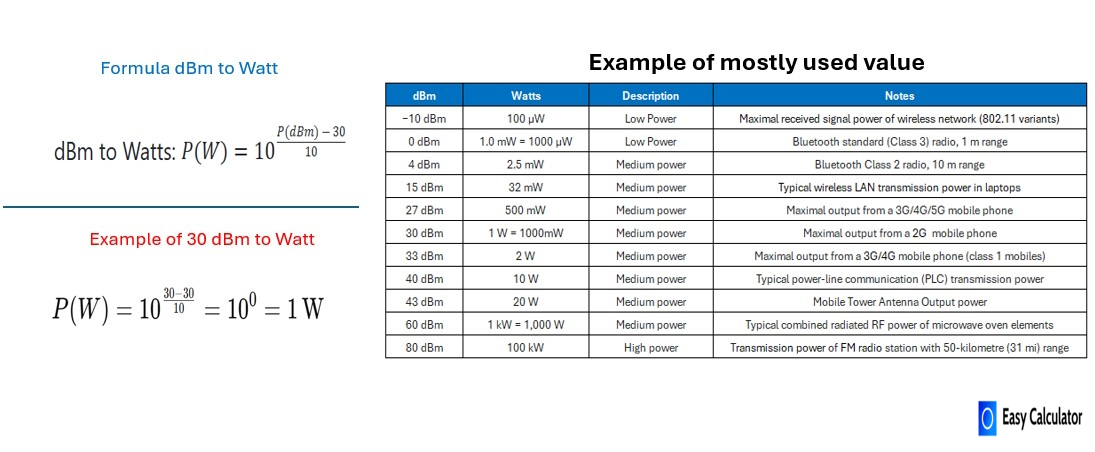
dBm to Watt Conversion Table
This table provides common dBm to Watt conversions from very low power levels through high power levels. Values are calculated using: P(W)=10(dBm − 30) / 10.
| dBm | Watts (W) | Power Level |
|---|---|---|
| −30 dBm | 0.000001 W | Very low |
| −25 dBm | 0.000003 W | Very low |
| −20 dBm | 0.000010 W | Very low |
| −15 dBm | 0.000032 W | Very low |
| −10 dBm | 0.000100 W | Very low |
| −5 dBm | 0.000316 W | Low |
| 0 dBm | 0.001000 W | Reference |
| 5 dBm | 0.003162 W | Low |
| 10 dBm | 0.010000 W | Low |
| 15 dBm | 0.031623 W | Low |
| 20 dBm | 0.100000 W | Low |
| 25 dBm | 0.316228 W | Moderate |
| 30 dBm | 1.000000 W | Moderate |
| 31 dBm | 1.258925 W | Moderate |
| 32 dBm | 1.584893 W | Moderate |
| 33 dBm | 1.995262 W | Moderate |
| 34 dBm | 2.511886 W | Moderate |
| 35 dBm | 3.162278 W | Moderate |
| 36 dBm | 3.981072 W | Moderate |
| 37 dBm | 5.011872 W | Moderate |
| 38 dBm | 6.309573 W | Moderate |
| 39 dBm | 7.943282 W | Moderate |
| 40 dBm | 10.000000 W | Moderate |
| 41 dBm | 12.589254 W | High |
| 42 dBm | 15.848932 W | High |
| 43 dBm | 19.952623 W | High |
| 44 dBm | 25.118864 W | High |
| 45 dBm | 31.622777 W | High |
| 46 dBm | 39.810717 W | High |
| 47 dBm | 50.118723 W | High |
| 48 dBm | 63.095734 W | High |
| 49 dBm | 79.432823 W | High |
| 50 dBm | 100.000000 W | High |
| 55 dBm | 316.227766 W | Very high |
| 60 dBm | 1,000.000000 W | Very high |
| 65 dBm | 3,162.277660 W | Very high |
| 70 dBm | 10,000.000000 W | Very high |
| 75 dBm | 31,622.776602 W | Very high |
| 80 dBm | 100,000.000000 W | Very high |
| 90 dBm | 1,000,000.000000 W | Very high |
FAQ About dBm to Watts
0 dBm=0.001 W=1 mW. It is the reference point used by the dBm scale.
10 dBm=0.01 W=10 mW.
20 dBm=0.1 W=100 mW.
30 dBm=1 Watt. This is one of the most useful reference points when converting between dBm and Watts.
37 dBm ≈ 5.01 Watts.
40 dBm=10 Watts.
43 dBm ≈ 19.95 Watts, commonly rounded to approximately 20 W.
46 dBm ≈ 39.81 Watts, commonly rounded to approximately 40 W.
A negative dBm value means the power is below 1 mW. For example, −10 dBm=0.1 mWand −30 dBm=0.001 mW.
dBm uses a logarithmic scale, which makes it convenient for expressing very small and very large power levels and for working with RF gains and losses.
dBdescribes a ratio or relative difference between quantities, while dBmrepresents an absolute power level referenced to 1 mW.
Use the formula P(W)=10(P(dBm) − 30) / 10. For example, 30 dBm gives 1 W, while 40 dBm gives 10 W.