Watt to dBm Calculator
Convert Watts to dBm instantly and accurately.


Watt to dBm Conversion: Formula, Examples & Table
Watt to dBm conversion changes an absolute power value in Watts (W) into decibel-milliwatts (dBm). Use this free Watt to dBm Calculator to convert power values in Watts, milliwatts (mW), microwatts (µW), and nanowatts (nW) to dBm quickly and accurately.
Watt is the SI unit of power, while dBm is a logarithmic unit referenced to 1 milliwatt. dBm is widely used for expressing RF and communication power levels in wireless networks, radio systems, Wi-Fi, LTE, 5G, microwave links, and fiber-optic communication.
How to Convert Watts to dBm
To convert power from Watts to dBm, use the following formula:
Where:
- P(dBm)=power level in dBm
- P(W)=power in Watts
- log10=base-10 logarithm
The +30 in the formula comes from the relationship between Watts and milliwatts. Since 1 W=1,000 mW, and 1,000=103, converting 1 Watt to dBm gives:
Therefore, 1 Watt=30 dBm.
Input requirement: Power must be greater than zero. P(W) in the formula is the numerical power value in watts. Zero watts has no finite dBm value (the limit is −∞ dBm); negative watts cannot be converted using this real-valued logarithmic formula.
How to Convert Milliwatts to dBm
If your power value is already given in milliwatts, the conversion is simpler because dBm is referenced directly to 1 mW:
For example:
Examples of Watt to dBm Conversion
Here are some common examples showing how to convert power in Watts to dBm.
Example 1: Convert 1 Watt to dBm
Use the Watt to dBm formula:
Since log10(1)=0:
1 W=30 dBm
Example 2: Convert 5 Watts to dBm
Substitute 5 W into the formula:
log10(5) ≈ 0.699
=10 × 0.699 + 30
Therefore, 5 W ≈ 36.99 dBm, or approximately 37 dBm.
Example 3: Convert 10 Watts to dBm
Using the formula:
=10 + 30
Therefore, 10 W=40 dBm.
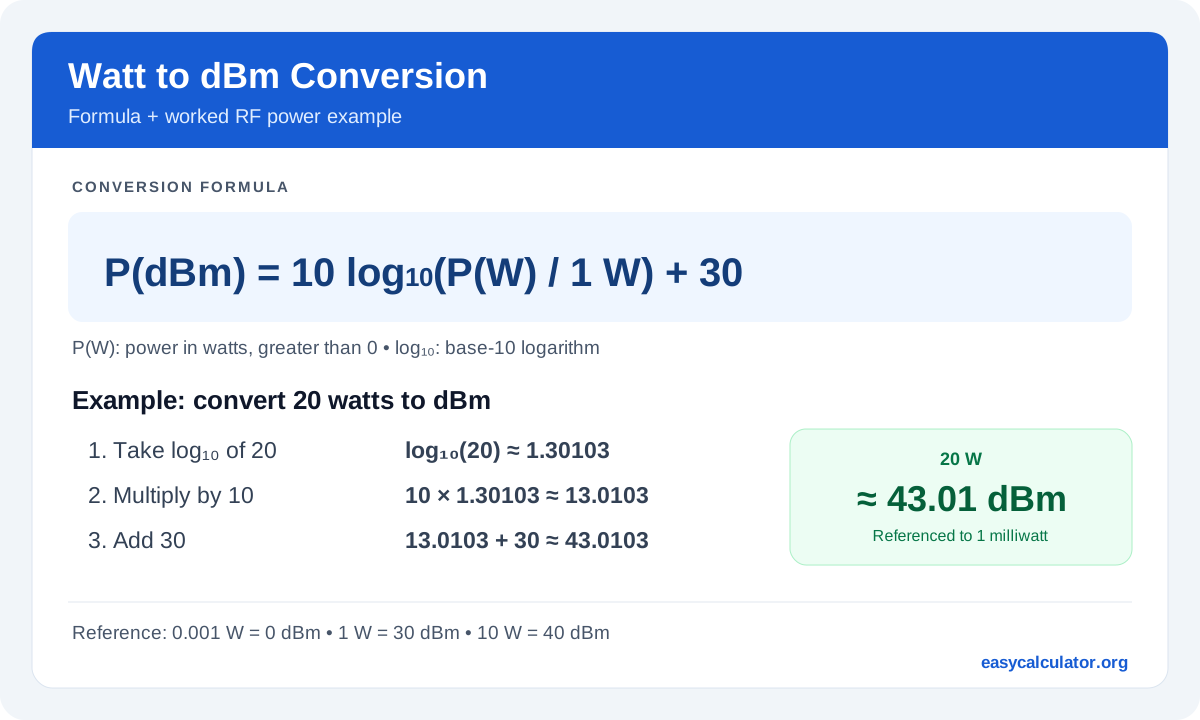
Example 4: Convert 20 Watts to dBm
Substitute 20 W into the formula:
log10(20) ≈ 1.30103
=10 × 1.30103 + 30
Therefore, 20 W ≈ 43.01 dBm.
Example 5: Convert 40 Watts to dBm
Using the formula:
log10(40) ≈ 1.602
=10 × 1.602 + 30
Therefore, 40 W ≈ 46.02 dBm.
Watt to dBm Conversion Table
Compare power in watts, milliwatts and dBm. Non-integer dBm values are rounded to two decimal places.
| Watts | Milliwatts | dBm |
|---|---|---|
| 0.000001 W | 0.001 mW | −30 dBm |
| 0.00001 W | 0.01 mW | −20 dBm |
| 0.0001 W | 0.1 mW | −10 dBm |
| 0.001 W | 1 mW | 0 dBm |
| 0.01 W | 10 mW | 10 dBm |
| 0.1 W | 100 mW | 20 dBm |
| 1 W | 1,000 mW | 30 dBm |
| 5 W | 5,000 mW | 36.99 dBm |
| 10 W | 10,000 mW | 40 dBm |
| 20 W | 20,000 mW | 43.01 dBm |
| 40 W | 40,000 mW | 46.02 dBm |
| 50 W | 50,000 mW | 46.99 dBm |
| 100 W | 100,000 mW | 50 dBm |
| 1,000 W | 1,000,000 mW | 60 dBm |
Why Is dBm Used in RF Engineering?
RF systems can involve power levels ranging from extremely small received signals to very high transmitter outputs. Using Watts for every value can result in inconveniently small or large numbers.
The logarithmic dBm scale provides a compact way to express absolute power. It is especially useful when working with transmitter output, receiver sensitivity, amplifier gain, cable loss, antenna systems, and RF link budgets.
Another advantage is that power gains and losses can be handled conveniently using decibel arithmetic. This is one reason dBm is commonly found in RF equipment specifications and communication-system measurements.
Use the RF Link Budget Calculator to combine transmitter power with gains and losses, or the EIRP Calculator to account for antenna gain and feeder losses. For the reverse conversion, use the dBm to Watt Calculator.
Where Is Watt to dBm Conversion Used?
Watt to dBm conversion is useful when equipment specifications or measured power are given in Watts but RF calculations require dBm. Common applications include:
LTE & 5G Networks
Transmitter specifications may be given in Watts, while RF planning and link-budget calculations commonly use dBm. For example, 20 W ≈ 43.01 dBm.
Wi-Fi & Wireless Networks
Converting transmitter power from Watts to dBm helps compare power levels with antenna gain, cable losses, and receiver sensitivity.
RF Transmitters
RF transmitters and power amplifiers may be rated in Watts, while system-level RF calculations use dBm.
Microwave Communication
Microwave links use dBm for power budgets and measurements. Converting equipment output from Watts to dBm makes it easier to combine transmitter power, antenna gain, and path losses.
Fiber-Optic Systems
Optical power is commonly expressed in dBm. Converting between Watts, milliwatts, and dBm is useful when comparing optical transmitter and receiver power levels.
Watt, Milliwatt and dBm Relationship
Watts and milliwatts are linear units of power, while dBm is logarithmic. The basic relationship between them is:
- 1 W=1,000 mW=30 dBm
- 0.1 W=100 mW=20 dBm
- 0.01 W=10 mW=10 dBm
- 0.001 W=1 mW=0 dBm
Every 10 dB increase corresponds to a 10× increase in power. Therefore, increasing from 30 dBm to 40 dBm increases power from 1 W to 10 W. Increasing from 40 dBm to 50 dBm increases power from 10 W to 100 W.
FAQ About Watt to dBm
Use the formula P(dBm) = 10 × log10(P(W)) + 30. For example, 1 W = 30 dBm and 10 W = 40 dBm.
1 Watt = 30 dBm.
5 Watts ≈ 36.99 dBm, usually rounded to approximately 37 dBm.
10 Watts = 40 dBm.
20 Watts ≈ 43.01 dBm.
40 Watts ≈ 46.02 dBm.
100 Watts = 50 dBm.
1 mW = 0 dBm. This is the reference power level for the dBm scale.
Yes. Power below 1 mW has a negative dBm value. For example, 0.1 mW = −10 dBm and 0.001 mW = −30 dBm.
dB represents a ratio or relative difference, while dBm represents an absolute power level referenced to 1 milliwatt.
No. Watts are a linear unit of power, while dBm is a logarithmic representation of power referenced to 1 mW. They can be converted using the appropriate formula.
Use P(dBm) = 10 × log10(P(mW)). For example, 10 mW = 10 dBm and 100 mW = 20 dBm.