VSWR Calculator
Convert VSWR, return loss, S11 and reflection coefficient. Calculate reflected power, accepted power and mismatch loss, or find SWR from forward and reflected power.
Choose your input
Example buttons switch to VSWR input. Results use full precision internally and are rounded for display.
- Return loss
- —
- Reflection magnitude |Γ|
- —
- Reflected power
- —
- Accepted power
- —
- Mismatch loss
- —
- S11 magnitude in dB
- —
Enter values and select Calculate to see your results.


What is VSWR?
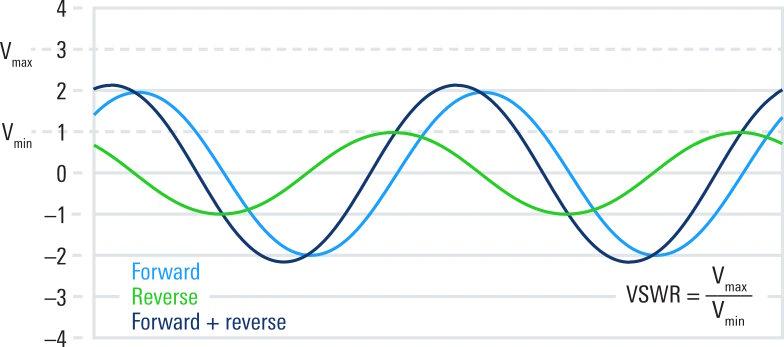
VSWR stands for Voltage Standing Wave Ratio. It is the ratio of the maximum to the minimum voltage amplitude in a standing wave on a transmission line. Reflections from an impedance mismatch create these voltage peaks and valleys. SWR is often used as shorthand for VSWR in antenna work.
A VSWR of 1:1 means no reflection at the measurement plane. A higher VSWR means more reflected power. It does not by itself describe antenna gain, radiation efficiency or coverage.
How to use this VSWR calculator
- Select the quantity you know: VSWR, return loss, S11, reflection magnitude, power or standing-wave voltages.
- Enter your value. Use positive dB for return loss and zero or negative dB for S11.
- Select Calculate to see all conversions. For power mode, enter forward and reflected power in watts at the same measurement plane.
- Use the example buttons or download the calculated results as CSV.
VSWR formula and related equations
Let ρ = |Γ| be the magnitude of the voltage reflection coefficient. For a passive load with a real reference impedance, 0 ≤ ρ ≤ 1.
| Quantity | Formula |
|---|---|
| VSWR from reflection coefficient | VSWR = (1 + ρ) / (1 − ρ) |
| Reflection magnitude from VSWR | ρ = (VSWR − 1) / (VSWR + 1) |
| Return loss in dB | RL = −20 log₁₀(ρ) |
| Return loss to reflection magnitude | ρ = 10−RL/20 |
| S11 magnitude in dB | S11(dB) = 20 log₁₀(ρ) = −RL |
| Reflected power percentage | 100 × ρ² |
| Accepted power percentage | 100 × (1 − ρ²) |
| Mismatch loss in dB | ML = −10 log₁₀(1 − ρ²) |
| Standing-wave voltage ratio | VSWR = Vmax / Vmin |
| Reflection magnitude from power | ρ = √(Pr / Pf) |
Pf is forward power and Pr is reflected power. Use the same units and measurement plane for both. Vmax and Vmin are the standing-wave maximum and minimum amplitudes, not the incident and reflected wave amplitudes.
VSWR from impedance
Γ = (ZL − Z0) / (ZL + Z0)
ZL is the load impedance and Z0 is the real characteristic impedance of the line. For a complex load, calculate the complex Γ and use its magnitude in the VSWR formula. VSWR alone cannot determine a unique load impedance because reflection phase is unknown.
Return loss to VSWR calculator
Choose Return loss above to convert a positive return-loss value in dB into VSWR. For example, 10 dB return loss gives ρ ≈ 0.31623 and VSWR ≈ 1.925:1. Exactly 10% of incident power is reflected.
VSWR = (1 + 10−RL/20) / (1 − 10−RL/20)
Lower VSWR and higher positive return loss both indicate a better impedance match. Return loss is not the same as insertion loss or mismatch loss.
VSWR to return loss conversion chart
Use this table to compare common VSWR values with return loss, reflected power and mismatch loss.
| VSWR | Return loss (dB) | Reflected (%) | Mismatch loss (dB) |
|---|---|---|---|
| 1:1 | ∞ | 0.00 | -0.00 |
| 1.1:1 | 26.44 | 0.23 | 0.01 |
| 1.15:1 | 23.13 | 0.49 | 0.02 |
| 1.2:1 | 20.83 | 0.83 | 0.04 |
| 1.3:1 | 17.69 | 1.70 | 0.07 |
| 1.4:1 | 15.56 | 2.78 | 0.12 |
| 1.5:1 | 13.98 | 4.00 | 0.18 |
| 1.7:1 | 11.73 | 6.72 | 0.30 |
| 2:1 | 9.54 | 11.11 | 0.51 |
| 2.5:1 | 7.36 | 18.37 | 0.88 |
| 3:1 | 6.02 | 25.00 | 1.25 |
| 3.5:1 | 5.11 | 30.86 | 1.60 |
| 4:1 | 4.44 | 36.00 | 1.94 |
| 5:1 | 3.52 | 44.44 | 2.55 |
| 10:1 | 1.74 | 66.94 | 4.81 |
VSWR calculation examples
1. VSWR 1.5:1
ρ = (1.5 − 1) / (1.5 + 1) = 0.2. Reflected power is 0.2² × 100 = 4%; return loss is 13.98 dB. With 100 W forward power, 4 W is reflected and 96 W is accepted at that plane.
2. VSWR 2:1 in dB
A 2:1 VSWR gives ρ = 1/3, return loss 9.54 dB and S11 −9.54 dB. Mismatch loss is 0.51 dB. Specify which dB quantity you mean because these values describe different things.
3. Forward and reflected power
For Pf = 100 W and Pr = 25 W, ρ = √(25/100) = 0.5. VSWR = 1.5/0.5 = 3:1. Accepted power is 75 W, and mismatch loss is about 1.25 dB.
4. Maximum and minimum voltage
If Vmax = 5 V and Vmin = 2 V, VSWR = 5/2 = 2.5:1. Return loss is approximately 7.36 dB and reflected power is 18.37%.
Common percentage checks: 1.4:1 reflects 2.78%, 1.7:1 reflects 6.72%, 4:1 reflects 36%, and 5:1 reflects 44.44%. Square the reflection magnitude to calculate the power fraction.
What is a good VSWR?
A perfect match is 1:1. A 1.5:1 match reflects 4% of incident power, while 2:1 reflects 11.11%. Whether either value is acceptable depends on the antenna specification, operating frequency, transmitter limits and project acceptance criteria. There is no universal pass/fail threshold for every RF system.
A low VSWR does not prove that an antenna radiates efficiently. A matched dummy load can have low VSWR while turning accepted RF power into heat. Lossy feeder cable can also make the input match appear better than the match at the antenna.
Causes of high VSWR and practical checks
Possible causes include damaged feeders, loose or poorly fitted connectors, water ingress, the wrong antenna band, and nearby objects changing antenna impedance. Check the specified operating band and component impedance, inspect connections, and measure across the operating band with calibrated equipment at a documented reference plane. Follow the equipment's RF shutdown and test procedures.
Frequently Asked Questions About VSWR
What is the full form of VSWR?
VSWR stands for Voltage Standing Wave Ratio. In antenna work, SWR often refers to the same voltage standing-wave ratio.
How do I convert return loss to VSWR?
Calculate ρ=10−RL/20, then VSWR=(1 + ρ) / (1 − ρ), where RL is return loss in dB. A return loss of 10 dB corresponds to approximately 1.925:1 VSWR.
What is 1.5:1 VSWR in return loss?
A VSWR of 1.5:1 corresponds to 13.98 dB return loss, a reflection coefficient magnitude of 0.2 and 4% reflected power.
What is 2:1 VSWR in dB?
A 2:1 VSWR corresponds to 9.54 dB return loss, −9.54 dB S11magnitude and 0.51 dB mismatch loss. VSWR itself is a ratio.
Can VSWR be less than 1?
For the passive-load model used here, VSWR cannot be less than 1. Write a VSWR of 1.5 as 1.5:1, not 1:1.5.
What happens at VSWR 1:1 or total reflection?
At 1:1, reflected power is zero and return loss is ideally infinite. At total reflection, |Γ|=1, reflected power is 100%, return loss is 0 dB and VSWR tends to infinity.
Is accepted power the same as antenna efficiency?
No. Accepted power is incident power minus reflected power at the reference plane. Antenna radiation efficiency is the fraction of accepted power that is radiated. It depends on dissipative losses and cannot be calculated from VSWR alone.
Can I calculate VSWR from S11?
Yes. For S11magnitude expressed in dB, use |Γ|=10S11(dB)/20, then VSWR=(1 + |Γ|) / (1 − |Γ|). Enter zero or negative S11dB values for this passive-load model.