Hexadecimal to Binary Converter
0
Quick Examples
Enter a hexadecimal value to see the conversion steps here.
Other Conversions


Hexadecimal to Binary Converter
A Hexadecimal to Binary Converter helps convert hexadecimal numbers (base-16) into binary numbers (base-2). This conversion is widely used in computer programming, digital electronics, and number system studies.
Replace each hexadecimal digit with its 4-bit binary equivalent and combine all the binary groups to get the final binary number.
What Is the Hexadecimal Number System?
The hexadecimal number system is a base-16 number system. It uses digits 0–9 and letters A–F, where A = 10 and F = 15.
What Is the Binary Number System?
The binary number system is a base-2 number system used by computers. It uses only two digits: 0 and 1, where 1 represents ON and 0 represents OFF.
How to Convert Hexadecimal to Binary
- Write the hexadecimal number
- Convert each hexadecimal digit into a 4-bit binary value
- Keep leading zeros where necessary
- Combine all binary groups in the same order
- The result is the binary number
Example: Convert 3A (Hexadecimal) to Binary
| Hexadecimal Digit | Binary (4-bit) |
|---|---|
| 3 | 0011 |
| A | 1010 |
3A₁₆ = 00111010₂
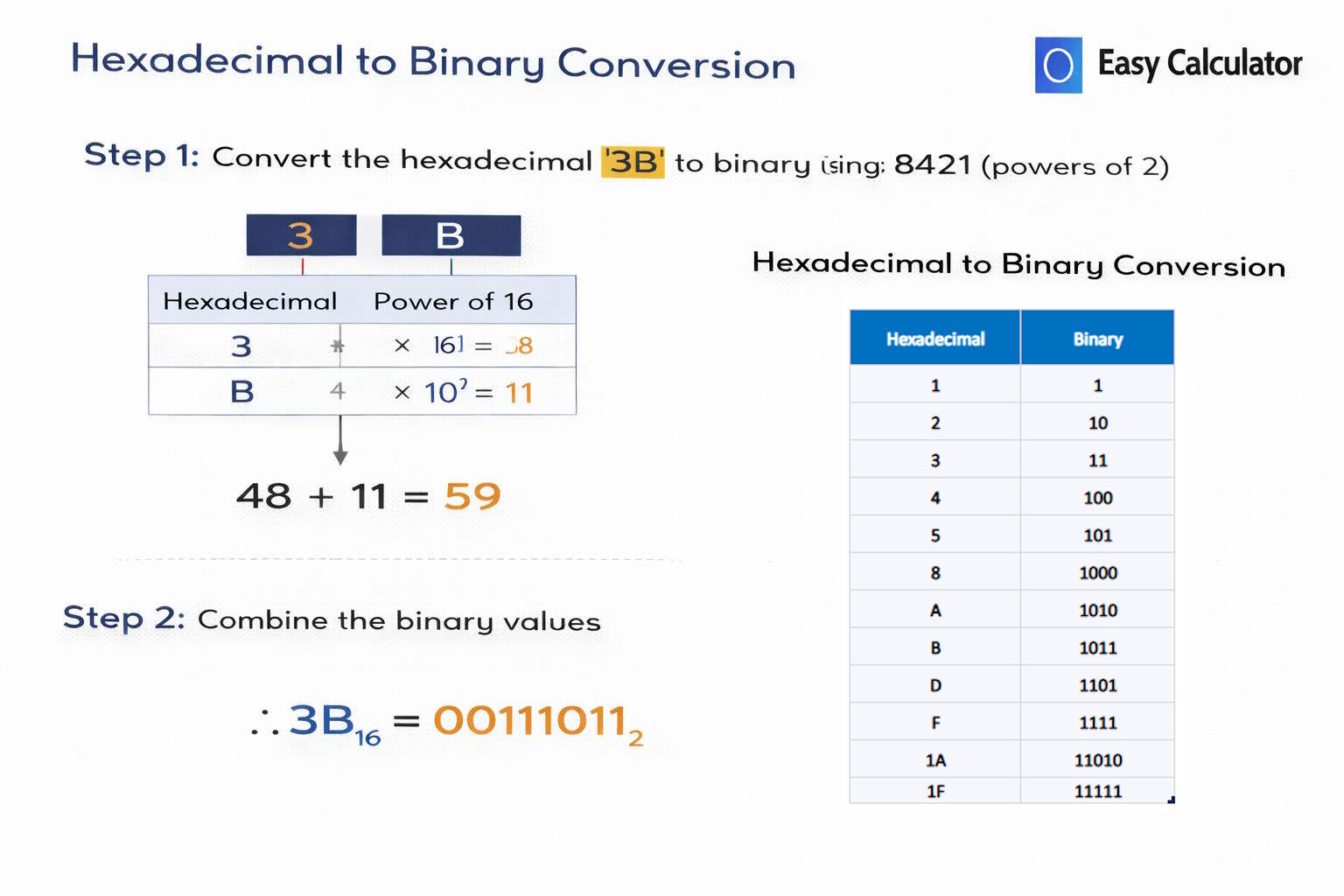
Hexadecimal to Binary Conversion Table
| Hexadecimal | Binary |
|---|---|
| 0 | 0000 |
| 1 | 0001 |
| 2 | 0010 |
| 3 | 0011 |
| 4 | 0100 |
| 5 | 0101 |
| 6 | 0110 |
| 7 | 0111 |
| 8 | 1000 |
| 9 | 1001 |
| A | 1010 |
| B | 1011 |
| C | 1100 |
| D | 1101 |
| E | 1110 |
| F | 1111 |
FAQ on Hexadecimal to Binary Converter
Hexadecimal to binary conversion is the process of converting a base-16 number into a base-2 number by replacing each hexadecimal digit with its 4-bit binary equivalent.
Because hexadecimal is base-16 and 2⁴ equals 16, so each hexadecimal digit maps exactly to four binary bits.
The easiest way is using a direct hex-to-binary table and converting each digit into its 4-bit binary form.