Prime Number Checker
Instantly test whether a number is prime or composite


What is a Prime Number?
A prime number is a natural number greater than 1 that has exactly two factors: 1 and itself. These numbers cannot be divided evenly by any other number, making them fundamental in mathematics and number theory.
For example, 2, 3, 5, and 7 are prime numbers because they are only divisible by 1 and themselves.
Properties of Prime Numbers
Prime numbers have several important properties:
- They are always greater than 1
- They have exactly two divisors
- They cannot be formed by multiplying smaller natural numbers
- There are infinitely many prime numbers
- Every number greater than 1 can be expressed as a product of prime numbers
This last property is known as the Fundamental Theorem of Arithmetic, which makes prime numbers the “building blocks” of all numbers.
Examples of Prime Numbers
Prime numbers are numbers that are divisible only by 1 and themselves. Here are some common examples:
Key Points
- ✔ 2 is the only even prime number
- ✔ All other prime numbers are odd
- ✔ 1 is not considered a prime number
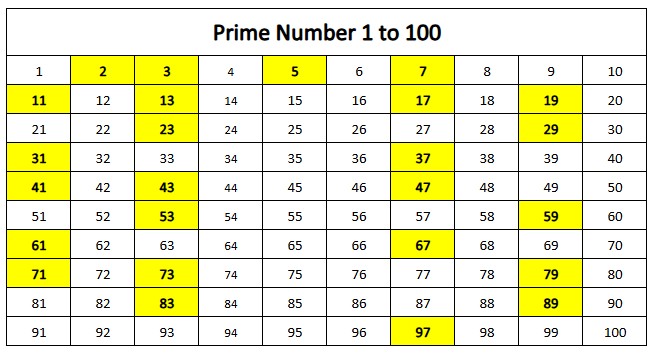
Prime numbers from 1 to 100
Why Is 1 Not a Prime Number?
1 is not a prime number.
A prime number must have exactly two factors: 1 and itself.
The number 1 has only one factor, which is 1. Therefore, it does not meet the definition of a prime number.
Is 2 a Prime Number?
Yes, 2 is a prime number.
It has exactly two factors:
The number 2 is special because it is the only even prime number. Every other even number can be divided by 2 and therefore has more than two factors.
Prime Numbers vs Composite Numbers
Prime and composite numbers are different because of the number of factors they have.
| Prime Number | Composite Number |
|---|---|
| Has exactly two factors | Has more than two factors |
| Greater than 1 | Greater than 1 |
| Example: 7 | Example: 12 |
| Factors of 7: 1, 7 | Factors of 12: 1, 2, 3, 4, 6, 12 |
For example, 7 is primebecause only 1 and 7 divide it exactly.
But 12 is compositebecause it can be divided by 1, 2, 3, 4, 6, and 12.
How to Check if a Number Is Prime
You can use a simple method to check whether a number is prime.
- Make sure the number is greater than 1.
- Try dividing it by smaller numbers.
- If another number divides it exactly, it is not prime.
- If no other number divides it exactly, the number is prime.
Example: Is 29 a Prime Number?
Let's check 29:
- 29 cannot be divided evenly by 2.
- 29 cannot be divided evenly by 3.
- 29 cannot be divided evenly by 5.
You can also use our Prime Number Checkerto check a number quickly.
What Are the Factors of a Prime Number?
A prime number has exactly two factors.
For example:
So, the factors of 13 are 1 and 13.
Therefore, the factors of 17 are 1 and 17.
Why Are Prime Numbers Important?
Prime numbers are important in mathematics because they are the basic building blocks of whole numbers.
For example:
The number 12 can be broken down into prime numbers.
Prime numbers are also used in areas such as computer science, encryption, and cybersecurity.
Interesting Facts About Prime Numbers
- 2is the smallest prime number.
- 2is the only even prime number.
- 1 is not a prime number.
- There are 25 prime numbers from 1 to 100.
- Prime numbers continue forever.
- Numbers greater than 1 can be broken down into prime factors.
Use the Prime Number Checker
Not sure whether a number is prime? Enter a number into our Prime Number Checkerto quickly find out whether it is a prime or composite number.
The tool is useful for students, teachers, and anyone working with numbers.
Check a NumberFrequently Asked Questions About Prime Numbers
1. What is a prime number?
A prime number is a whole number greater than 1 that has exactly two factors: 1 and itself. Examples include 2, 3, 5, 7, and 11.
2. Is 1 a prime number?
No. The number 1 is not prime because it has only one factor. A prime number must have exactly two factors.
3. Is 2 a prime number?
Yes. 2 is a prime number and is the only even prime number.
4. How many prime numbers are there between 1 and 100?
There are 25 prime numbersbetween 1 and 100.
5. What is the smallest prime number?
The smallest prime number is 2.
6. Is 7 a prime number?
Yes. 7 is prime because its only factors are 1 and 7.
7. What is the difference between a prime and composite number?
A prime number has exactly two factors, while a composite number has more than two factors. For example, 7 is prime and 12 is composite.
8. Are there infinitely many prime numbers?
Yes. There are infinitely many prime numbers, so there is no largest prime number.
Did You Know?
- Around 300 BC, the mathematician Euclid proved that there are infinitely many prime numbers.
- The Sieve of Eratosthenes is one of the oldest and fastest methods to find prime numbers.
- Prime numbers are used in encryption and cybersecurity to protect online transactions.
- Some primes come in pairs like (11, 13), called twin primes.
You can also use our Prime Number Finder tool above to quickly check whether any number is prime or not.