MGRS Converter
Convert MGRS to lat long or latitude and longitude to MGRS.
Choose grid precision, copy your coordinates or find a location on the map. Uses WGS84 coordinates between 80°S and 84°N.
Location access requires your permission. Grid precision does not indicate your device’s positioning accuracy. Polar UPS references are not supported by this tool.
Converted coordinates
MGRS Map: Click to Find Coordinates
Convert a coordinate to place a marker, or click the map to convert that point. The map is a basemap with a location marker, not an MGRS grid overlay.


What is MGRS?
The Military Grid Reference System (MGRS)is a standard coordinate system used by NATO military forces to find and share locations anywhere on Earth. It is based on the Universal Transverse Mercator (UTM)and Universal Polar Stereographic (UPS) systems and divides the world into numbered zones and lettered latitude bands.
MGRS was designed to make location reporting fast and easy for soldiers and marines. Instead of using long UTM coordinates, MGRS converts them into a shorter and more readable format while still maintaining high accuracy.
How the MGRS System Works
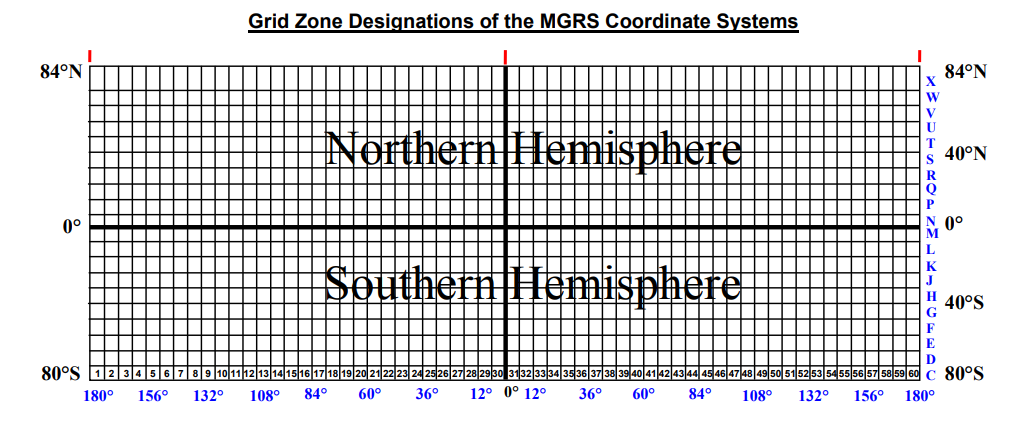
The MGRS coordinate starts with a Grid Zone Designator (GZD). The Earth is divided into:
- 60 vertical longitudinal zones
- Latitude bands usually 8° high
- Band X is 12° high
The latitude bands are labeled from C (80° South)to X (84° North). The letters Iand Oare not used to avoid confusion with numbers.
100,000-Meter Grid Squares
Each grid zone is further divided into 100,000-meter squares. Every square is identified using two letters:
The first lettershows the easting direction (west → east)
The second lettershows the northing direction (south → north)
These letters replace some digits of UTM coordinates, making MGRS coordinates shorter and easier to use in the field.
How to Convert MGRS to Latitude and Longitude
- Enter a full MGRS reference, including its grid zone and two square letters.
- Select Convert MGRS to Lat Long.
- Copy the decimal-degree coordinates or open the location in Google Maps.
For example, 31U DQ 48252 11955 identifies a 1 m grid near the Eiffel Tower in Paris, approximately 48.8584° N, 2.2945° E. This converter returns the approximate centre of the supplied grid cell. A short reference describes a larger area, so its centre is not necessarily the original measurement point.
How to Convert Lat Long to MGRS
Enter latitude first and longitude second in decimal degrees. Use negative numbers for south and west. Select the grid precision, then choose Convert Lat Long to MGRS. For example, enter 48.8584 and 2.2945 to locate the Eiffel Tower area.
For your current position, select Find My Current Location in MGRS and allow browser location access. The result shows the accuracy estimate supplied by your device when available.
MGRS Coordinate Structure
An MGRS coordinate is made up of three main parts: the Grid Zone Designator, the 100,000-meter square identifier, and the numerical location.
4QGrid Zone Designator
Identifies the general area of the Earth.
- Zone: 1–60
- Latitude band: C–X
- Each zone is 6° wide
- I and O are not used
FJ100 km Square
Identifies a 100 km × 100 km grid square.
- Uses two letters
- Unique within a grid zone
- Helps narrow the location
12345678Numerical Location
Gives the position inside the 100 km square.
- First half=easting
- Second half=northing
- More digits=greater precision
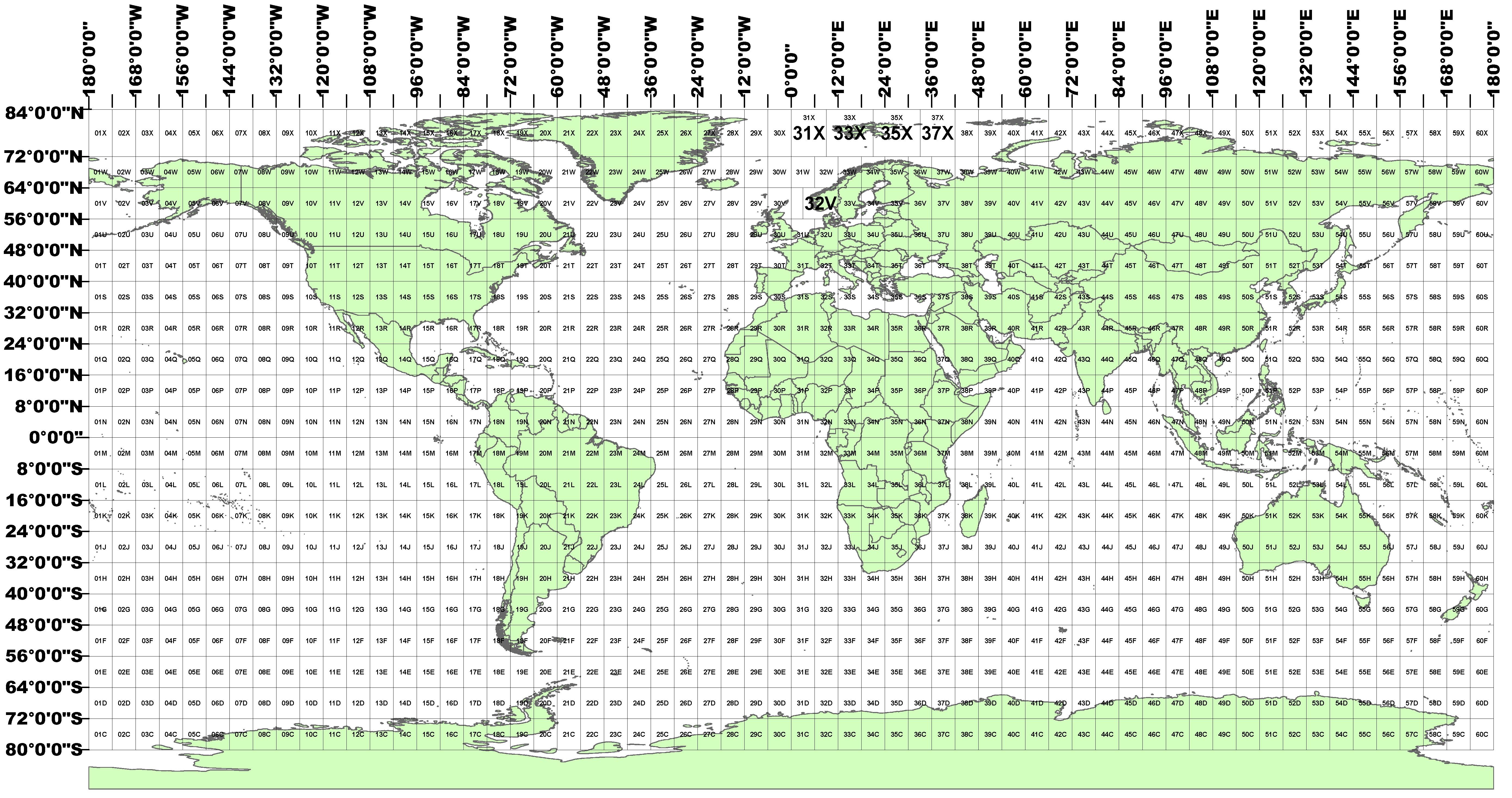
Earth's MGRS Grid
MGRS divides the Earth into zones and latitude bands to create a consistent grid for identifying locations.
Longitudinal Zones
- 60 zones numbered 1–60
- Each zone is 6° wide
- Zone 1 starts at 180°W
- Zone 60 ends at 180°E
Latitude Bands
- 20 bands labeled C–X
- Most bands are 8° high
- Band X is 12° high
- I and O are skipped
Example Conversion
Input (MGRS)
31U DQ 48252 119551-meter precision coordinate
Output (Lat/Long)
approximately 48.858405, 2.294507WGS84 datum
Why Use an MGRS Converter?
An MGRS converter makes it easy to convert between MGRS coordinates and latitude and longitude for mapping, navigation, and location-based tasks.
Military Operations
Useful for tactical maps, mission planning, and navigation.
Disaster Response
Helps identify and share locations quickly during emergencies.
GIS & Mapping
Makes it easier to work with coordinates in mapping applications.
Outdoor Activities
Useful for navigation when exploring remote or unfamiliar areas.
Surveying
Helps professionals work with grid coordinates and geographic locations.
Drone Operations
Helps convert geographic coordinates for UAV mapping and navigation.
MGRS, UTM and GPS: What Is the Difference?
GPS is a satellite positioning system. Latitude/longitude, UTM and MGRS are ways to express a location. UTM uses a zone with numerical easting and northing; MGRS adds grid-square letters and shorter paired digits. Most UTM zones are 6° wide, with special zone arrangements in Norway and Svalbard.
MGRS also has a polar form based on UPS. This particular converter supports the UTM portion from 80°S to 84°N and WGS84 coordinates only. It does not transform older map datums or supply altitude.
Download MGRS Boundary Files
Download global MGRS grid boundaries in multiple GIS formats: GeoJSON, KML, and Shapefile.
FAQ on MGRS Converter
An MGRS converter changes Military Grid Reference System coordinates into latitude and longitude coordinates, or converts latitude and longitude into an MGRS coordinate.
Enter the MGRS coordinate into the MGRS to Latitude and Longitude converter and select Convert. The tool returns the corresponding latitude and longitude.
Enter the latitude and longitude values into the Latitude and Longitude to MGRS converter and select Convert to MGRS.
MGRS is a more readable version of UTM with added letters to represent 100,000-meter squares, simplifying map reading for military use.
MGRS can be as precise as 1 meter. The longer the coordinate, the higher the precision.
Yes, it’s widely used in emergency services, GIS software, and land surveying because of its accuracy and universal format.
MGRS is used by NATO member countries, including the United States, United Kingdom, Canada, Germany, France, Italy, and many allied nations. It is also widely used by emergency responders, search and rescue teams, humanitarian organizations, surveyors, and GIS professionals worldwide for accurate location reporting and navigation.
Yes. MGRS coordinates can be converted offline using compatible GIS software, GPS devices, military mapping applications, or desktop tools. However, our online MGRS Converter provides a fast, free, and convenient way to convert between MGRS and latitude/longitude without installing any software.
An MGRS coordinate is read from left to right. It begins with the Grid Zone Designator (GZD), followed by the 100,000-meter grid square identifier, and finally the easting and northing values. For example, in 33TWN8567932516, 33Tis the grid zone, WNidentifies the 100 km square, and the remaining digits specify the exact location within that square. More digits indicate higher precision, with Ten numerical digits identify a 1 m grid square. Actual positional accuracy depends on the source coordinates and positioning device.
MGRSand GPSare not the same. GPS provides a location using latitude and longitude coordinates, while MGRS is a grid-based coordinate system built on the WGS84 datum and commonly used by military organizations, emergency responders, and GIS professionals. GPS devices can display coordinates in MGRS format, making navigation easier in tactical and field operations.
Did You Know?
1. MGRS can pinpoint a location on Earth with precision up to 1 meter, making it one of the most accurate and efficient coordinate systems used in global military and emergency operations.
📍 Geolocation Tools
References: MapTools MGRS guide, Proj4js MGRS conversion library.