LCM Calculator
Find the least common multiple of 2 to 5 numbers, with calculation steps.
Least Common Multiple (LCM)
Input numbers:
HCF / GCD:
Exact integer resultCalculation steps
For each pair: LCM(a, b)=(a ÷ GCD(a, b)) × b. Repeat using the previous LCM and the next number.
Prime factorization
| Number | Prime factors |
|---|
Take the highest power of each prime across all the inputs.


What Is LCM? A Simple Explanation
LCM stands for Least Common Multiple. It is the smallest positive whole number that two or more numbers can divide into exactly, with nothing left over.
That sounds a little tricky! Let’s break the name into three easy parts:
- Least means smallest.
- Common means shared.
- Multiple is a number you get by multiplying a number by 1, 2, 3, and so on.
For example, the positive multiples of 4 are 4, 8, 12, 16, 20, 24, …. You can find them by counting in fours.
Remember: To find the LCM, look for the first number that appears in both lists of positive multiples.
How to Use the LCM Calculator
- Enter your first number in Number 1.
- Enter your second number in Number 2.
- If you have more numbers, fill in the optional boxes. You can enter up to 5 numbers.
- Click Calculate LCM. Your answer and calculation steps appear below the buttons.
- Open Prime factorization to see another way to understand the answer.
Use positive whole numbers from 1 to 1,000,000,000. Do not enter zero, negative numbers, fractions, or decimals.
Click Try example to calculate the LCM of 12, 18, and 24. The answer is 72. Click Reset to clear the calculator.
Method 1: List the Multiples
This is a good method to try first, especially with small numbers.
Example: Find the LCM of 4 and 6
| Number | Positive multiples |
|---|---|
| 4 | 4, 8, 12, 16, 20, 24, … |
| 6 | 6, 12, 18, 24, 30, 36, … |
Both lists contain 12 and 24. But 12 is the smallest shared number.
So, LCM(4, 6) = 12.
Another Example: Find the LCM of 12 and 16
- Multiples of 12: 12, 24, 36, 48, 60, …
- Multiples of 16: 16, 32, 48, 64, …
The first shared number is 48. Therefore, LCM(12, 16) = 48.
Method 2: Use Prime Factors
A factor divides a number exactly. A prime number is a whole number greater than 1 with only two positive factors: 1 and itself. Some prime numbers are 2, 3, 5, and 7.
Prime factorization means breaking a number into prime numbers that multiply together to make it.
Example: Find the LCM of 12 and 18
- 12 = 2 × 2 × 3
- 18 = 2 × 3 × 3
For each prime number, take the most copies you see in either line:
- Take two copies of 2, because 12 needs two.
- Take two copies of 3, because 18 needs two.
LCM = 2 × 2 × 3 × 3 = 36.
The calculator may write repeated multiplication using powers. For example, 2^2 means 2 × 2, and 3^2 means 3 × 3.
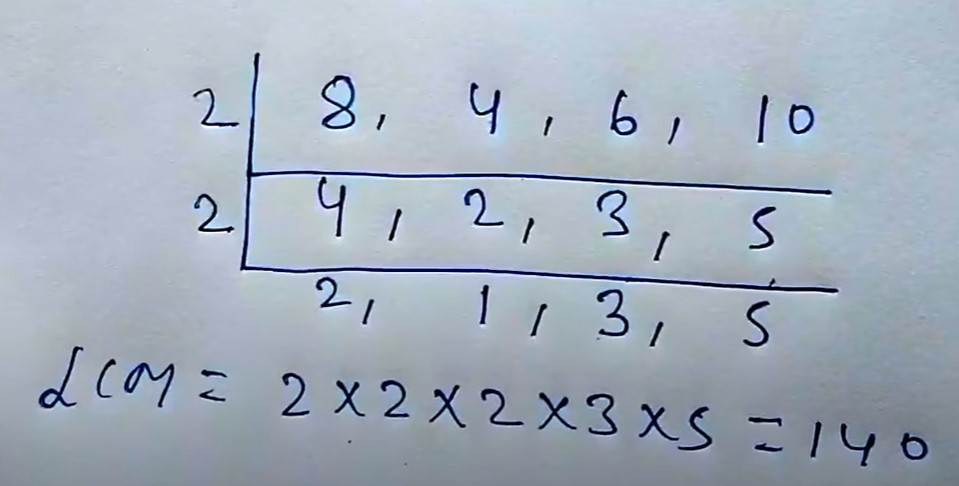
Method 3: Use the Division Method
The division method helps when you have several numbers. Let’s find the LCM of 20, 30, and 50.
- Write the numbers in a row.
- Choose a prime number that divides at least one number in the row exactly.
- Divide the numbers you can. If a number cannot be divided exactly, copy it into the next row unchanged.
- Repeat until every number is 1.
- Multiply all the prime numbers you used as divisors.
| Divide by | First number | Second number | Third number |
|---|---|---|---|
| 2 | 20 | 30 | 50 |
| 2 | 10 | 15 | 25 |
| 3 | 5 | 15 | 25 |
| 5 | 5 | 5 | 25 |
| 5 | 1 | 1 | 5 |
| Finished | 1 | 1 | 1 |
Multiply the divisors in the first column:
LCM = 2 × 2 × 3 × 5 × 5 = 300.
Check: 300 ÷ 20 = 15, 300 ÷ 30 = 10, and 300 ÷ 50 = 6. None leaves a remainder.
The LCM Formula Using HCF
The HCF (Highest Common Factor) is the largest whole number that divides both numbers exactly. It is also called the GCD (Greatest Common Divisor).
For two positive whole numbers, you can use this shortcut:
LCM = (first number × second number) ÷ HCF
For example, the HCF of 12 and 18 is 6.
LCM = (12 × 18) ÷ 6 = 216 ÷ 6 = 36.
With three or more numbers, work through them two at a time. For 12, 15, and 20:
- Find LCM(12, 15) = 60.
- Then find LCM(60, 20) = 60.
So, LCM(12, 15, 20) = 60. Do not use “multiply all the numbers and divide by their HCF” as a shortcut for three or more numbers.
How to Find LCM Using the Division Method
Let’s find the LCM of 20, 30, and 50. Divide by prime numbers such as 2, 3, and 5. If a number cannot be divided exactly, carry it down unchanged.
| Divide by | First number | Second number | Third number |
|---|---|---|---|
| 2 | 20 | 30 | 50 |
| 2 | 10 | 15 | 25 |
| 3 | 5 | 15 | 25 |
| 5 | 5 | 5 | 25 |
| 5 | 1 | 1 | 5 |
| Finished | 1 | 1 | 1 |
Step-by-Step Explanation
- Divide by 2: 20, 30, and 50 become 10, 15, and 25.
- Divide by 2 again: 10 becomes 5. Carry down 15 and 25 unchanged.
- Divide by 3: 15 becomes 5. The other numbers stay the same. We now have 5, 5, and 25.
- Divide by 5: 5, 5, and 25 become 1, 1, and 5.
- Divide by 5 again: We get 1, 1, and 1. Now stop.
Multiply all the divisors in the first column:
LCM = 2 × 2 × 3 × 5 × 5 = 300
Check the Answer
- 300 ÷ 20 = 15
- 300 ÷ 30 = 10
- 300 ÷ 50 = 6
Every division has no remainder. The division method gives 300 as the smallest positive number divisible by all three numbers.
Where Do We Use LCM?
Finding When Events Happen Together
Imagine one light flashes every 4 seconds and another flashes every 6 seconds. They flash together now. When will they next flash together?
The LCM of 4 and 6 is 12, so they will next flash together in 12 seconds.
Adding Fractions
To add 1/4 + 1/6, first make the bottom numbers, called denominators, the same.
The LCM of 4 and 6 is 12. So, 1/4 = 3/12 and 1/6 = 2/12.
1/4 + 1/6 = 3/12 + 2/12 = 5/12.
Common Mistakes to Avoid
- Choosing any shared multiple: 24 is a common multiple of 4 and 6, but their LCM is 12 because it is smaller.
- Always multiplying the inputs: 4 × 6 = 24, but the LCM of 4 and 6 is 12.
- Mixing up LCM and HCF: For 4 and 6, the LCM is 12 and the HCF is 2.
- Changing a number that does not divide exactly: In the division method, copy that number unchanged into the next row.
Try These Yourself
List the multiples first. Then use the calculator to check your answers.
- Find the LCM of 3 and 5.
- Find the LCM of 6 and 8.
- Find the LCM of 4, 6, and 10.
Show answers
- LCM(3, 5) = 15.
- LCM(6, 8) = 24.
- LCM(4, 6, 10) = 60.
Watch: How to Find the LCM
Watch this lesson by Periwinkle to learn about the Least Common Multiple. Then try your own examples using the LCM calculator above.
Video credit: Periwinkle.
FAQ on LCM
1. What is the easiest way to find the LCM?
For small numbers, listing the multiples is an easy place to start. Find the first positive number that appears in every list. For larger numbers, prime factors or the division method can save time.
2. Can the LCM be smaller than an input number?
For positive whole numbers, no. The LCM is always at least as large as the largest input. For example, the LCM of 4 and 8 is 8.
3. What is the difference between LCM and HCF?
LCM is the smallest positive multiple shared by the numbers. HCF is the largest whole number that divides them all exactly. For 6 and 8, the LCM is 24 and the HCF is 2.
4. Can I find the LCM of more than two numbers?
Yes. This calculator accepts 2 to 5 positive whole numbers. For example, the LCM of 4, 6, and 10 is 60.
5. What is the LCM of 1 and another number?
The LCM of 1 and any positive whole number is that other number. For example, the LCM of 1 and 9 is 9, because 9 divides exactly by both 1 and 9.